
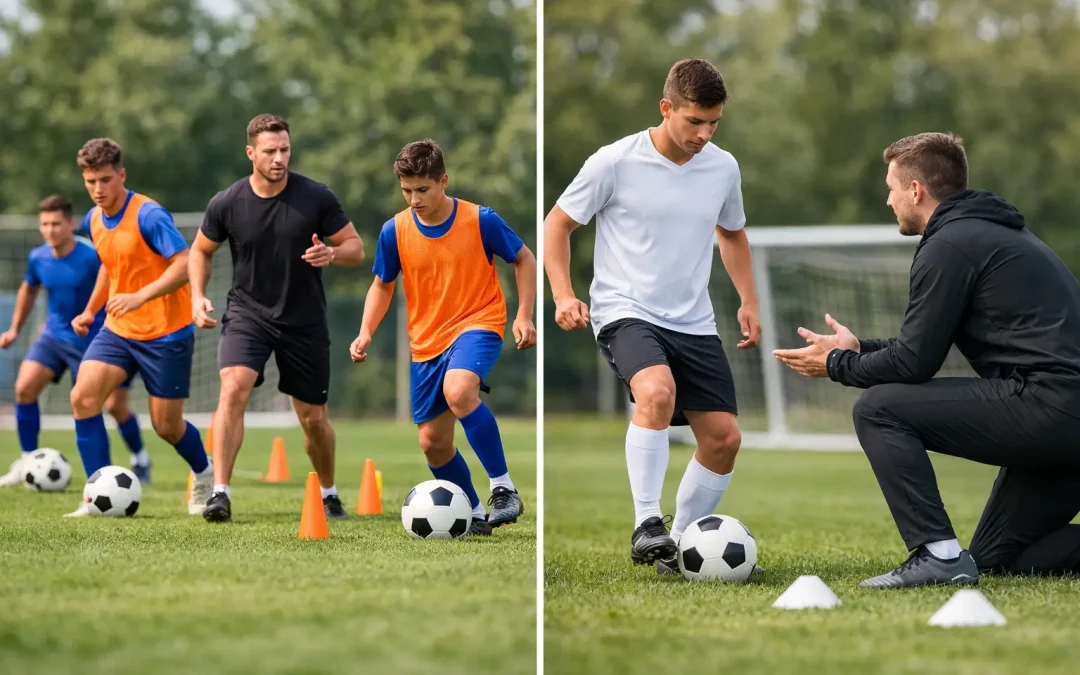
A player can work hard at team training every week and still feel unsure when the ball arrives on match day. They may need more touches, clearer feedback, or the confidence to make decisions under pressure. That is why the choice between group training vs private sessions matters. The right format is not simply about what is more challenging or more convenient. It is about what will move the player forward at their current stage of development.
For some players, one-on-one coaching provides the fastest path to correcting a technical weakness or preparing for trials. For others, a small group creates the competitive environment they need to become more composed, aware and confident. Strong development often includes both, but the balance should reflect the player’s goals, age, position and current needs.
What private football sessions are designed to deliver
Private sessions place the player at the centre of every drill, decision and coaching conversation. There is no waiting in a line for the next turn and no need for a coach to split attention across a full group. The session can focus closely on one issue, whether that is receiving on the back foot, improving weaker-foot passing, shooting technique, speed of movement, goalkeeper handling, or confidence in one-versus-one situations.
This level of individual attention is particularly valuable when a player has a clear goal. A winger preparing for representative trials may need to improve their first touch at speed and their final ball. A young defender may need to understand body shape, timing and how to delay an attacker. A goalkeeper might need repeated work on set position, footwork and distribution. Private coaching gives the coach time to assess the detail, explain why it matters, and revisit it until the player can perform it consistently.
The value is not just in getting more repetitions. It is in getting purposeful repetitions. If a player practises a movement incorrectly for hundreds of touches, the habit becomes harder to change. Immediate feedback helps players understand what their body is doing and how to make a practical adjustment on the next attempt.
When private coaching is the stronger choice
Private sessions are often a smart option for players who are new to football and need a solid technical foundation before they feel comfortable in a group. They also suit ambitious players who have identified a specific area holding them back, such as turning under pressure, striking the ball cleanly or improving their non-dominant foot.
They can be especially useful before club trials, selection periods or a new season, when a player wants a structured block of work around their position and performance targets. Senior players can also benefit from private training when they need position-specific detail that is difficult to receive during a busy club session.
That said, private coaching is not a replacement for playing with others. Football is a team game. A player must eventually apply their technique while reading teammates, opponents, space and pressure. That is where group training has a different and equally important role.
Why group training develops match-ready players
Group sessions create situations that look and feel more like football. Players have to scan before receiving, react to a teammate’s movement, protect the ball, communicate and make decisions when the space is limited. These are skills that cannot be fully developed in isolation.
A well-coached group is not just a collection of drills. It is a learning environment where players are challenged to compete, collaborate and solve football problems. Small-sided games are particularly valuable because they give each player frequent involvement. There are more passes, more transitions, more chances to defend and more moments where a player has to decide quickly.
For younger players, group training also builds social confidence. They learn to listen, take turns, encourage others and recover after a mistake without withdrawing from the session. For parents, this matters as much as technical progress. A player who feels capable around other footballers is more likely to enjoy training, ask for the ball and stay committed to their development.
The standard of the group makes a difference. Being surrounded by players with good habits can lift intensity and accountability. Players learn that sharp passing, quick recovery runs and positive communication are expected, not optional. At the same time, a group must be appropriately matched. If the gap in ability is too wide, some players may be under-challenged while others spend the session trying to keep up.
Group training vs private sessions: the key trade-offs
The decision comes down to focus versus game realism. Private sessions offer maximum individual coaching, a tailored plan and a high number of quality repetitions. Group training offers pressure, competition, communication and the unpredictability that makes football such a demanding sport.
Neither format is automatically better. A player struggling with basic ball mastery may gain more from private work before joining a higher-level group. A technically tidy player who disappears in matches may need group sessions that force quicker decisions and stronger communication. A player returning from a break may need confidence-building individual sessions first, then a gradual return to competitive group work.
Parents should also consider how the player responds to each environment. Some young footballers thrive when they have the coach’s full attention and clear individual targets. Others are energised by training alongside friends and testing themselves against players at a similar level. The best setting is one where the player is engaged, challenged and willing to keep working when an exercise becomes difficult.
Choosing the right format for your player
Start with the player’s immediate goal. If they are preparing for trials, ask what selectors are likely to notice in their position. Is it first touch, speed of play, defending, composure, distribution or game awareness? If the answer is highly specific, private coaching can create a focused development plan.
Next, assess whether the player can transfer training habits into match situations. A player who performs well in unopposed drills but rushes when challenged needs more competitive exposure. Group sessions can help them learn to execute their technique while being pressed, tired or forced to make a decision quickly.
Age and experience also matter. A child aged five to eight often benefits from a balance of simple individual guidance and enjoyable group activities. Their priorities are building coordination, ball familiarity and confidence. Older players may need more position-specific work, physical intensity and tactical detail, especially if they are targeting academy, representative or senior opportunities.
It is also worth looking at what the player already receives through their club. Team training is essential, but coaches must manage a full squad and prepare for the weekend’s match. There is rarely enough time to give every player detailed individual correction. Supplementary private or group training can fill that gap without competing with the club environment.
A combined approach can create stronger progression
For many developing footballers, the most effective pathway is not an either-or decision. A private session can identify and improve the technical detail. A group session can then test that improvement in live football situations. For example, a player may spend individual time learning how to receive on the half-turn, then use small-sided games to practise scanning, receiving and playing forward under pressure.
This combination gives players a clearer connection between practice and performance. They begin to understand that better technique is not just about looking good in a drill. It helps them keep possession, beat pressure, create chances and contribute more confidently to the team.
At Clinical Football, coaching formats can be matched to where a player is now and where they want to go next. The aim is not to push every player into the same program. It is to give them the right challenge, clear feedback and a development structure that makes progress measurable.
The most useful question is not whether private or group training is best. Ask what your player needs to improve next, then choose the environment that gives them the greatest chance to practise that skill with purpose, confidence and consistency.