
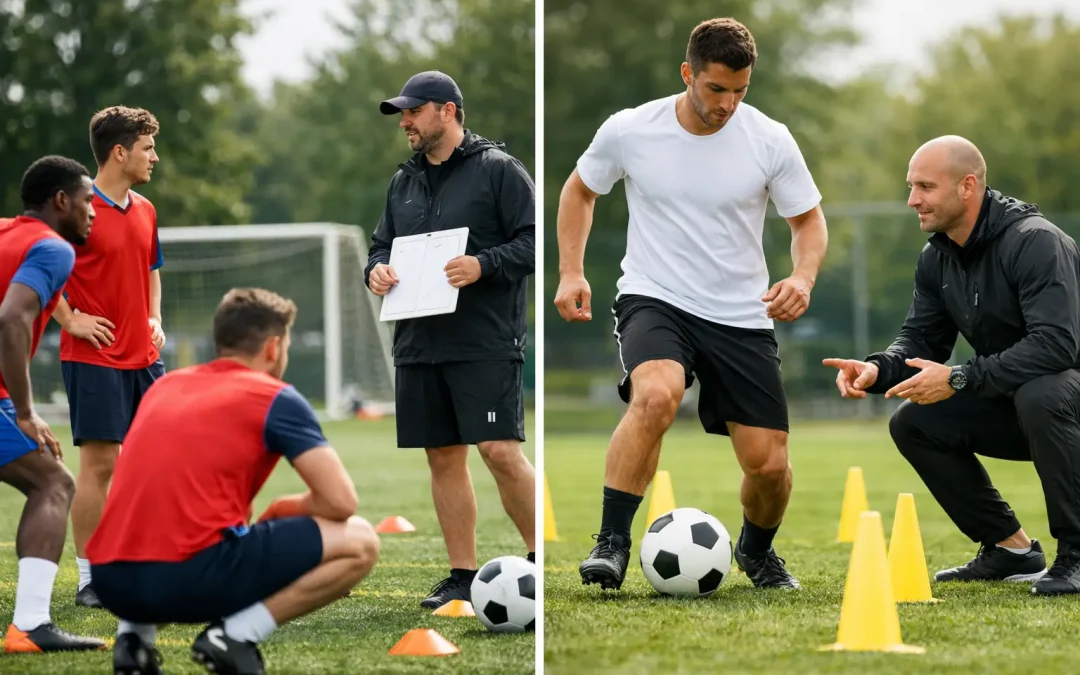
A player who looks sharp in a one-on-one session may still need to learn how to scan, combine and make decisions with teammates around them. Equally, a player working hard at club training can still carry the same weak first touch or hesitation into every match. That is why the group football training vs private coaching decision is not simply about choosing the ‘best’ option. It is about choosing the right environment for the player’s current needs, goals and stage of development.
For Sydney families, the answer is often a planned mix rather than one format forever. Private coaching can accelerate a specific area of performance. Group training can test that improvement under pressure and build the football intelligence that only comes from playing with and against others. The key is knowing what each format is designed to do.
What private football coaching does best
Private football coaching gives a player something difficult to find in a busy team session: focused attention. Every repetition, correction and progression can be shaped around the individual. For a young player, that may mean building confidence receiving the ball with both feet. For an advanced winger, it may mean improving the first movement, change of pace and final delivery needed to create chances.
A quality private session should not just be a collection of drills. It should identify where the player is now, establish a clear target and build training that moves them towards it. The coach can slow down a technical action, demonstrate it clearly, correct body position and repeat the skill until the player begins to own it.
This level of detail is particularly valuable when a player has a specific goal. They may be preparing for representative trials, returning from time away from football, moving into a new position or struggling with a part of their game that is holding them back. A goalkeeper who needs better footwork and handling, for example, will benefit from position-specific work that is not possible in a general team session.
Private coaching also suits players who need a confidence reset. Some children stay quiet in a large group because they are worried about making mistakes. In a supportive one-on-one setting, they can ask questions, take risks and receive feedback without feeling overlooked. That confidence needs to transfer back into matches, but it often starts with individual attention.
The limitation of private sessions
Football is not performed in isolation. A player can improve their passing technique in a private session, yet still struggle to choose the right pass when an opponent closes space, a teammate makes a run or the game speed rises. Private training develops the tools, but players must also learn when and why to use them.
It is also important that private coaching does not become overly dependent. The goal is not for a player to wait for constant instruction. The goal is to help them become more independent, more aware and more capable of solving problems on the pitch.
What group football training develops
Group football training places players in the situations where football decisions matter. They must communicate, compete, adjust to different teammates and deal with pressure. A pass is no longer just technically clean. It has to be weighted correctly, played at the right time and delivered into a teammate’s path.
In a well-coached group environment, players develop awareness as well as technique. They learn to scan before receiving, understand space, recognise overloads and respond when a drill or game does not go their way. These are habits that make a player more effective in weekend matches and more adaptable at trials.
The social side matters too, especially for younger players. Training alongside others can raise energy, encourage resilience and make football enjoyable. Players see different standards around them. A shy child may become more vocal. A technically strong player may learn patience and leadership. A competitive player may learn to manage frustration when the ball does not arrive as often as they want.
Small group sessions are especially useful because they offer more ball contact than a large team session while retaining real football interaction. With fewer players, a coach can still provide meaningful feedback, while the players get frequent chances to attack, defend, combine and make decisions.
The limitation of larger groups
The trade-off is coaching time. In a larger group, even an experienced coach cannot give every player extended individual feedback on every action. Players also arrive with different technical levels, learning styles and objectives. Sessions need to serve the group, which means one player’s particular weakness may not receive enough attention that day.
That does not make group coaching less valuable. It simply means it has a different job. Group coaching is excellent for match realism, decision-making and competitive growth. It may be less efficient for rebuilding an individual technical detail from the ground up.
Group football training vs private: choose by goal
Parents often ask which option will deliver faster improvement. The honest answer is that it depends on what needs improving.
Private coaching is usually the stronger choice when the goal is highly individual: refining ball mastery, improving weaker-foot confidence, correcting running mechanics, building striking technique, developing goalkeeper fundamentals or preparing for a position-specific trial. It is also effective when a player needs a structured plan and regular accountability.
Group training is usually the stronger choice when the player needs to improve awareness, speed of decision-making, communication, combination play, defending in realistic situations and confidence around other players. A player who dominates technical drills but disappears in matches often needs more football-specific pressure, not just more isolated repetition.
For a beginner aged five to eight, a small group can provide enjoyment and social confidence while introducing the basic skills of the game. If that player is finding a particular skill difficult, occasional private sessions can provide extra support without taking away the fun of training with friends.
For an ambitious teenage player, the balance may look different. Private sessions can target the qualities selectors notice, such as first touch, movement, finishing, speed mechanics or position-specific actions. Group work then gives that player the chance to apply those improvements when the space is tight and the decisions are live.
How to build a development plan that works
Training frequency should be realistic. More sessions are not automatically better if they lead to fatigue, loss of enjoyment or rushed recovery. Players need room for club training, matches, school, family life and physical development.
A useful starting point is to identify one or two priorities rather than trying to fix everything at once. Perhaps the player wants to become more confident receiving under pressure. Private work can focus on first touch, body shape and scanning habits. Group sessions can then demand those behaviours in possession games and small-sided matches.
Parents should also look beyond short-term results. A player may not suddenly score more goals after one private session, just as a group session will not instantly transform their decision-making. Real development comes from quality repetition, clear coaching, honest feedback and time to apply learning in competition.
At Clinical Football, sessions are most effective when they form part of a progression, not a one-off response to a disappointing match. Players should understand what they are working on, why it matters for their position and how it will help them perform with greater confidence.
Questions to ask before choosing a format
Start with the player, not the package. Ask what they enjoy, where they feel challenged and what they want to achieve over the next three to six months. Then consider what they are currently missing in their regular football environment.
If club training already provides plenty of realistic game play but limited technical feedback, private coaching may fill the gap. If a player trains individually often but needs to become braver and quicker around others, group work may be the better next step. If the player is preparing for trials, a combination can be particularly effective: individual refinement alongside competitive, game-based training.
The coach’s approach matters as much as the format. Look for sessions with purpose, age-appropriate challenges and feedback that teaches rather than simply criticises. Players should leave knowing what they did well, what needs work and what they can practise before the next session.
The best training choice is the one that gives a player a clear next step. Build the skill individually when detail is needed, test it with others when the game demands it, and keep moving forward with confidence.