
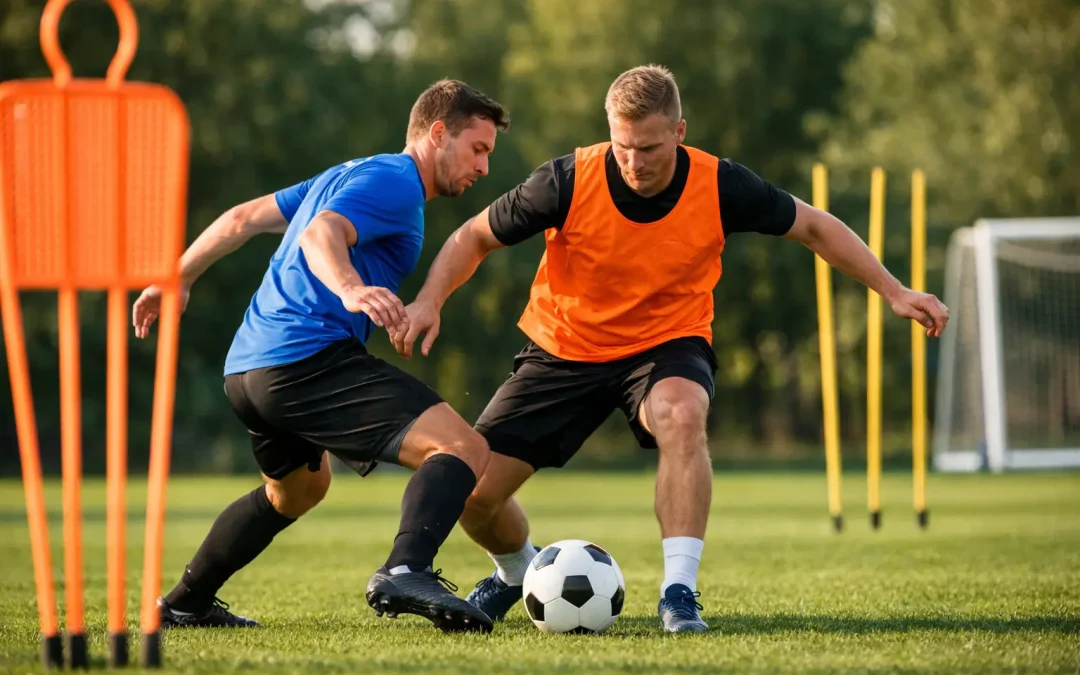
A defender can make ten smart decisions in a match and barely touch the ball. They might delay a quick winger, block a passing lane, organise a teammate and force play away from danger. That is why defender training drills for football must develop more than tackling. The best sessions teach players to read the game early, move with control and stay composed when the pressure rises.
For young players, defending can feel like a series of emergencies. A forward receives the ball, the defender rushes in, and one wrong step creates a chance. Structured position-specific coaching changes that pattern. Players learn what to see, where to stand and when to act – skills that build real confidence on match day.
What Great Defending Actually Looks Like
Strong defenders are not always the fastest or strongest players on the field. They are often the players who recognise danger first. They scan before the ball arrives, understand the space behind them and make the attacker’s next action more difficult.
At grassroots level, coaches often focus on the tackle because it is visible and exciting. A clean tackle matters, but it is usually the final action in a longer defensive sequence. Good defending begins with body position, distance, communication and patience. If a player can delay an attacker until support arrives, they have done an excellent job even without winning the ball.
Training should reflect the player’s age, role and current level. A nine-year-old may need to learn how to approach the ball under control. A teenage centre back preparing for representative trials may need to defend transitions, cover a teammate and deal with aerial balls. The principles remain consistent, while the detail and pressure progress.
Defender Training Drills for Football: Start With the 1v1
The controlled approach drill
Set up a channel around 12 to 15 metres long and 6 to 8 metres wide. The attacker begins with the ball at one end, while the defender starts several metres away. The attacker tries to dribble over the end line. The defender aims to stop them, force them wide or regain possession.
The coaching point is not to sprint straight at the ball. Defenders should arrive under control, slow down two or three metres from the attacker and adopt a side-on stance. Their front foot and body shape should show the attacker towards the less dangerous side, usually towards the touchline or away from the stronger foot.
For beginners, limit the attacker to one direction or ask them to use only their weaker foot. For more advanced players, give the attacker freedom and introduce a time limit. This makes the decision more realistic: should the defender tackle, delay or simply block the route to goal?
The recovery defending race
Many young defenders switch off after an attacker gets past them. This drill builds the habit of recovering immediately. Create a wider channel with a small goal at one end. The attacker starts ahead with the ball, while the defender begins a few metres behind or beside them. On the coach’s call, both players go live.
The defender must sprint back, get goal-side where possible and avoid diving into a tackle from behind. Once they are close enough, they should use their body position to reduce the shooting angle or apply pressure without fouling.
This drill is valuable because football is rarely perfect. Even quality defenders can be beaten by a first touch, a bounce or a quick combination. The response after that moment matters. Teach players that the play is not over until the ball is safe.
Build Positioning Before Adding More Pressure
The passing-lane interception game
Set up a rectangle with two target players at either end and two or three attackers in the middle. One defender works between the ball and the target. The attackers score by passing into either target player; the defender scores by intercepting or forcing a misplaced pass.
The defender should not chase every pass. Instead, they need to position themselves where they can see both the ball and the most dangerous opponent. Encourage a half-turned body shape, small adjustment steps and regular scanning.
This is one of the most effective defender training drills for football because it teaches anticipation without the fear of a physical duel. Players begin to understand that defending space can be as valuable as winning the ball. As they improve, add a second defender and coach communication: one presses, one covers.
Press, cover and balance
Use a grid with three attackers against three defenders, plus a small goal or end zone. The attackers try to play through the area, while the defenders work as a unit. Whenever one defender steps to the ball, the closest teammate provides cover behind them. The third defender protects the far side and watches runners.
Stop the drill briefly when needed and ask simple questions. Who is pressing? Where is the cover? If the ball is played wide, who protects the middle? These prompts help players connect their movement to the bigger picture rather than following the ball as individuals.
The trade-off is that too much stopping can reduce the intensity of the session. Use short coaching interventions, then let the players solve the next situation. Players learn tactical awareness most effectively when they can apply feedback straight away.
Develop Tackling Timing, Not Reckless Tackling
A tackle should be a decision, not a reflex. Defenders are most likely to win the ball when an attacker takes a heavy touch, looks down, receives with their back to goal or runs into a tight space. Training needs to help players identify these cues.
The touch-trigger tackle drill
In a small channel, the attacker dribbles towards a line while the defender tracks them. The defender is not allowed to tackle on the first few touches. They must stay balanced and wait for the attacker’s heavier touch before stepping in.
This restriction teaches patience. Young players often lunge because they want to win the ball immediately. By waiting for the trigger, they learn to tackle with better timing and less risk of being beaten or conceding a foul.
Coach players to use the foot closest to the ball where appropriate, keep their knees bent and stay ready for the next action. Winning the first contact is not enough if the ball rolls loose. The defender must secure possession, clear safely or find the next pass.
Make Drills Look More Like the Match
Isolated technique gives players the foundations, but game-based practice reveals whether those foundations hold up under pressure. Finish a defensive session with a conditioned small-sided game, such as 4v4 or 5v5, where defenders earn extra points for forcing play wide, making an interception or winning the ball and completing a pass.
Avoid rewarding only big tackles. If players receive praise only for sliding in, they may take unnecessary risks. Reward the quieter actions too: delaying a counterattack, covering a teammate, tracking a runner and communicating early.
For centre backs, add situations involving crosses, aerial balls and defending the box. For full backs, create wide 1v1s, overlapping runs and decisions about when to press. Defensive midfielders need repeated practice screening passes, receiving under pressure after a regain and protecting the space in front of the back line. Position-specific work gives ambitious players a clearer understanding of their role.
How Parents and Players Can Measure Progress
Progress is not just the number of tackles made. A developing defender may improve by staying goal-side more consistently, making fewer rushed challenges or communicating earlier with teammates. These changes are often the reason a player becomes more reliable in games.
Parents can support development by asking constructive questions after matches. Rather than focusing on mistakes, ask what the player noticed before an opponent received the ball, or whether they were able to show attackers away from goal. This keeps the conversation centred on learning and confidence.
At Clinical Football, individual and small-group sessions can give defenders the repetition and feedback that team training does not always allow. A coach can adjust the distance, speed and complexity of each drill so the player is challenged without being overwhelmed. That progression is especially valuable for players preparing for club trials or stepping into more competitive football.
The goal is not to create defenders who simply kick the ball away. It is to develop calm, intelligent players who protect their team, win key moments and have the confidence to play forward after the regain. Every well-timed step, smart recovery run and clear instruction to a teammate moves a player closer to that standard.