
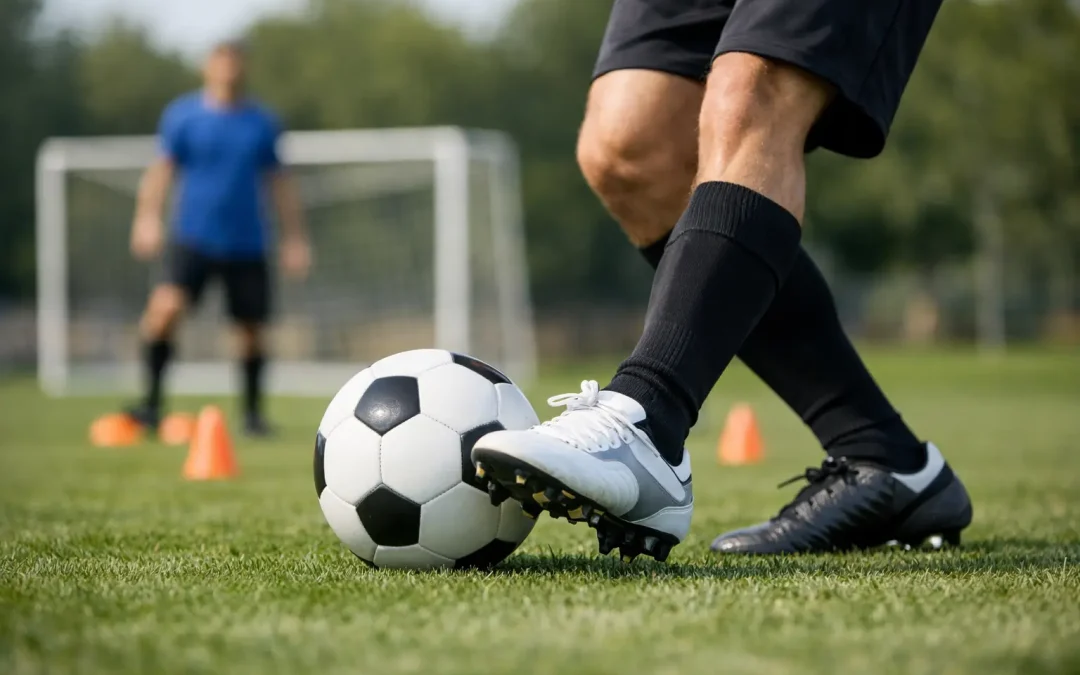
A player gets closed down on their strong side, shifts the ball onto the other foot, and the move breaks down straight away. That moment happens every weekend. If you want to know how to train weak foot properly, the goal is not just extra touches for the sake of it. The goal is to become more effective under pressure, more confident in possession, and harder to predict in matches.
For young players, this can be the difference between playing safe and playing freely. For older players, it often separates those who cope at a decent level from those who stand out in trials, team sessions, and big moments. A reliable weak foot does not appear overnight, but it does improve quickly when training is specific, consistent, and game-related.
Why weak foot training matters more than players think
Most players understand that using both feet is useful, but many still train in a way that keeps their strong foot dominant. They might complete a passing drill with the weaker side for a few minutes, then switch back as soon as the tempo rises. That feels productive, but it does not create real adaptation.
In football, a stronger weak foot gives you more than technical variety. It improves your body shape when receiving, opens different passing lanes, helps you protect the ball better, and reduces hesitation in tight spaces. Defenders can show you one way and still get beaten. Midfielders can play forward more often. Attackers can finish earlier instead of needing an extra touch.
There is also a confidence element. Players who do not trust their weak foot often panic before the ball even arrives. Their scanning drops, their first touch becomes rushed, and their decision-making narrows. Training the weaker side is as much about composure as technique.
How to train weak foot the right way
The biggest mistake is treating weak foot work like a punishment. If every repetition feels awkward and rushed, players lose focus and form. Good weak foot development starts with quality movement and simple actions, then builds toward speed, pressure, and match realism.
Start with isolated technique, but do not stay there too long. There is value in unopposed passing, wall work, and controlled striking because they help players feel the contact point, balance, and follow-through. But football is not played in isolation. Once the basic action looks cleaner, it needs to be tested with movement, scanning, and decision-making.
Volume matters as well. One long session each fortnight will not do much. Ten to fifteen focused minutes, added regularly, is usually far more effective. That is especially true for younger players who are still building coordination. Repetition creates familiarity, and familiarity creates confidence.
Build the base first
Before players start attempting difficult weak foot finishes or long switches, they need control of the basics. The first priority is clean contact with the ball.
Passing and receiving
Use short passes against a wall or with a partner. Focus on the inside of the foot, locked ankle, and body over the ball. Do not rush the tempo too early. If the technique breaks down, the repetition loses value.
Receiving matters just as much as passing. Take the first touch across the body, out of the feet, and into the next action. Many players can strike a weak foot pass in isolation but struggle to set it up with a useful first touch. That gap shows up immediately in games.
Ball mastery
Touches with the sole, inside, outside, and laces help the weaker foot feel less foreign. This is particularly important for younger players. Quick, controlled touches improve coordination and build comfort around the ball before pressure is introduced.
Striking technique
When players ask how to train weak foot for shooting, they often jump straight to power. That usually leads to poor habits. Start with placement from close range. Focus on balance, head steady, and a smooth follow-through. Once contact becomes consistent, power can be added.
Progress from technique to football actions
Once the weak foot is more reliable in simple drills, the next step is to make the training look like football.
Train on the move
Pass while moving, receive on different angles, and finish after a dribble. This forces the player to adjust their body shape and timing. In matches, the ball rarely arrives perfectly, so training should not always be perfect either.
Add directional pressure
Set up drills where the player must use the weak foot because of the angle, the defender’s position, or the next pass. This is far better than just telling them to use it. The environment should encourage the right action naturally.
Include decision-making
Weak foot development improves faster when players must read the game. For example, receive, scan, then choose whether to play short, turn, or finish. That is where real transfer happens. A player who can use the weaker side while thinking is far more prepared than one who can only perform in a set pattern.
Best drills to improve a weak foot
The most effective drills are usually simple. What matters is the quality of repetition and the progression.
Wall passing is one of the best starting points because it gives players many touches in a short period. Use one-touch and two-touch variations, then introduce movement between passes. A cone gate can help with direction and accuracy.
Cone dribbling with weak foot-only touches is useful for balance and control. Keep the distances realistic. Very tight cones can force sloppy technique if the player is not ready. Start with space, then tighten the area as control improves.
Weak foot finishing works best from close to goal first. Use cut-backs, near-post finishes, and first-time strikes. Then progress to finishing after a touch, finishing under passive pressure, and finishing from wider angles.
Rondos and possession games are excellent for older or more advanced players because they add pressure, awareness, and decision-making. The key is not forcing every touch onto the weak foot. Instead, create moments where using it becomes the best option.
Common mistakes that slow progress
Players often want quick results, but rushing the process creates frustration. One common mistake is trying advanced actions before the technique is stable. Another is training the weak foot only when energy is low at the end of a session. If the quality is poor, the habit becomes poor too.
There is also a balance to strike between commitment and realism. In a match, players should not force a weak foot action just to prove they can do it. The aim is to expand options, not ignore the strongest option. Good development means knowing when the weaker side helps the game and when it does not.
For parents, the best support is consistency rather than pressure. Younger players improve more when weak foot work is built into normal training and presented as part of becoming a complete footballer, not as a flaw that needs fixing.
How often should you train your weak foot?
For most players, three to five short blocks each week is enough to make visible progress. Younger players can benefit from ten-minute sessions built into regular ball work. Advanced players may need more specific repetition tied to their position.
A winger might focus on receiving inside and finishing with the far foot. A central midfielder may need more emphasis on receiving on the half-turn and playing forward under pressure. A defender might work on first-time clearances, switches, and safer weak foot passing angles. It depends on the player’s role, current level, and confidence.
Structured coaching can speed this up because the progressions are clearer. At Clinical Football, this is where individual coaching makes a real difference. Instead of generic drills, weak foot work can be built around the player’s age, position, and current technical gaps so improvement is measurable and relevant.
Confidence is built through repetition under pressure
A stronger weak foot is not about tricks or looking balanced in a warm-up. It is about solving football problems faster. When a player can receive either side, pass out of pressure, or finish without needing an extra touch, the whole game opens up.
That is why the best approach is steady and demanding at the same time. Start simple. Repeat the basics properly. Then increase speed, movement, and pressure until the weaker side becomes something you trust, not something you avoid.
The players who make the biggest jump are usually not the ones chasing perfect technique in one session. They are the ones who keep turning up, keep repeating the right actions, and keep building confidence until both feet can influence the game.