
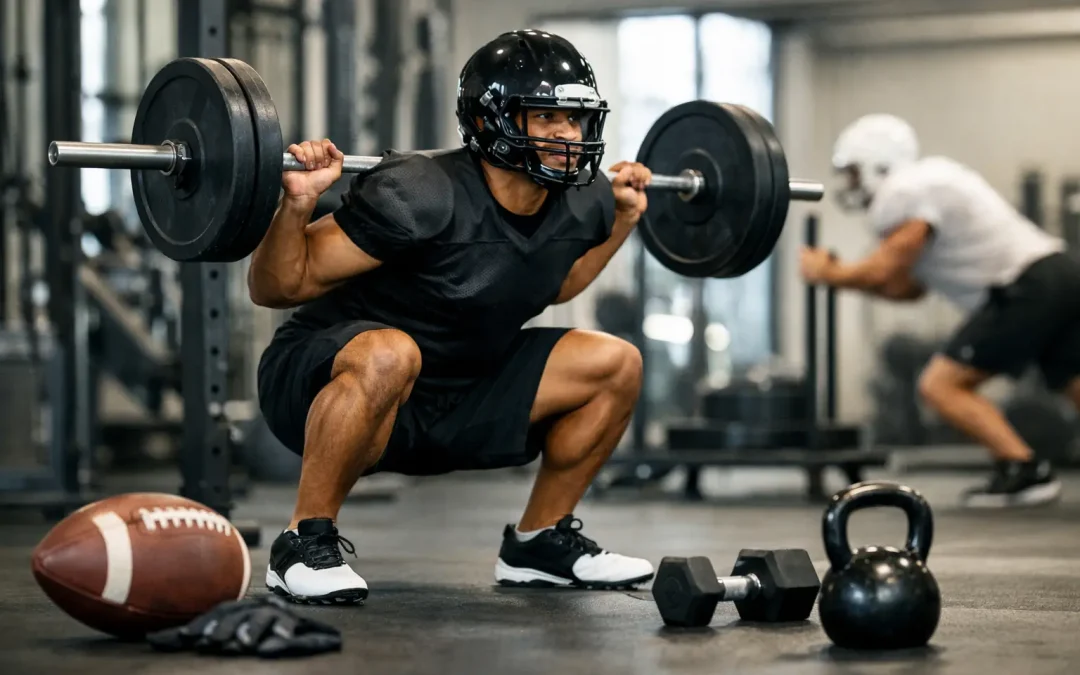
A stronger footballer is not simply the player who can lift the heaviest weight. It is the player who stays balanced under pressure, accelerates to a loose ball, holds position in a contest and keeps moving well late in the match. This guide to football strength training helps players and parents understand how to build those qualities safely, with training that supports football performance rather than distracting from it.
What football strength really means
Strength training for football is about producing and controlling force. A defender needs it to stay stable when an attacker tries to turn. A midfielder needs it to change direction repeatedly while protecting the ball. A winger needs it to push off quickly, brake safely and accelerate again. Goalkeepers need power through their legs and trunk to dive, land and get back to their feet.
That means a football strength programme should not look exactly like a bodybuilding programme. Building muscle can be useful for some older players, but size alone does not guarantee better performance. The priority is strength that transfers to the pitch: strong legs, stable hips, a controlled trunk, resilient ankles and the ability to move through a full range of motion.
For youth players, the goal is even more specific. Good coaching develops movement quality, coordination and confidence before loading exercises heavily. A child who learns to squat, land, lunge and push with control is building a valuable platform for future speed, power and injury resistance.
Guide to football strength training by age and stage
A player’s training age matters more than the number on their birthday. Some 13-year-olds have years of quality movement coaching; others are starting from scratch. Growth spurts also affect coordination, flexibility and recovery, so programmes must be adjusted rather than copied from professional players online.
Young players: build movement confidence
For players around ages five to 11, strength work should feel active, engaging and football-relevant. Bodyweight exercises, crawling patterns, balance challenges, short races and landing games are highly effective. The focus is on learning how their body moves.
A simple session might include squats to a target, forward and sideways lunges, bear crawls, low jumps with a quiet landing, planks and controlled skipping. These exercises can be woven into a football session without taking away from technical development.
The key coaching cues are straightforward: knees track in line with toes, chest stays proud, land softly and maintain control. Players do not need barbells to become stronger at this stage. They need regular exposure to well-coached movement.
Teenage players: develop strength with control
During adolescence, players can make significant strength gains, particularly when they are supervised and progress gradually. This is a useful period to introduce external resistance, including dumbbells, kettlebells, resistance bands and, where appropriate, barbells.
Technique comes first. A player should be able to perform a sound bodyweight squat before loading a goblet squat, and control a hip hinge before progressing to a deadlift variation. This approach protects the player while also producing better long-term results.
Teen players also need to manage the demands of school, team training, matches and growth. More training is not automatically better. Two focused strength sessions each week can be enough during the season, especially when the player is also training and playing regularly.
Senior and advanced players: train for position and demands
Older players can use a more structured programme that includes heavier strength work, power exercises and individual targets. A centre back may benefit from greater lower-body strength and upper-body control in aerial contests. A fullback may prioritise repeated acceleration, deceleration and single-leg strength. A central midfielder needs an all-round base to cope with the physical volume of the position.
Even at this level, the gym is only one part of development. Strength work must fit around football sessions, match minutes, sleep, nutrition and recovery. The best programme is the one a player can complete consistently while still feeling sharp on the pitch.
The movements every footballer should learn
Football strength training is most effective when it is built around a small number of movement patterns and progressed over time. Players do not need dozens of exercises. They need to perform the right ones well.
- Squat patterns develop leg strength and control for jumping, landing and holding position. Examples include bodyweight squats, goblet squats and split squats.
- Hip hinge patterns build the glutes and hamstrings, which are crucial for sprinting and protecting the back of the leg. Romanian deadlifts and hip bridges are useful options.
- Single-leg exercises improve balance and reduce side-to-side differences. Step-ups, reverse lunges and single-leg Romanian deadlifts are particularly relevant for football.
- Push and pull exercises strengthen the upper body for shielding, physical contests and general athletic balance. Push-ups, rows and band presses are practical choices.
- Trunk control exercises help players transfer force and resist unwanted movement. Planks, side planks, dead bugs and carries are more useful than endless sit-ups.
- Landing and jumping drills prepare players to absorb force safely and produce power when the time is right. Start with low, controlled jumps before progressing to more explosive work.
Quality matters at every stage. If a player’s knees collapse inwards during a landing or their back rounds during a hinge, reduce the load, simplify the exercise and rebuild the pattern. Pushing through poor technique does not build toughness. It creates poor habits.
Strength, speed and power are connected
Parents often ask whether strength work will make a player slower. When it is appropriately designed, the opposite is usually true. Strength gives a player more force to put into the ground. Better force production can support acceleration, jumping and change of direction.
But strength alone does not create speed. Players must also practise sprint mechanics, short accelerations and football actions at pace. A gym session can improve the engine; pitch work teaches the player how to use it in the moments that decide games.
Power work sits between the two. It teaches players to apply force quickly through jumps, bounds, medicine-ball throws and explosive movements. It should be introduced after players show good control and should never leave them exhausted before a key session or match.
How to organise a week of training
For most developing players, two strength sessions each week is a sensible starting point. Sessions can take 30 to 50 minutes and should be placed away from the most demanding football days where possible.
If a player has a Saturday match, a heavier lower-body session may suit Monday or Tuesday, provided they have recovered well. A lighter session focused on movement quality, trunk strength and upper-body work can fit later in the week. The exact schedule depends on the player’s age, training load, match day and current fitness.
Avoid hard leg sessions the day before a match. Sore, heavy legs can affect confidence and performance. During busy periods, reduce volume rather than abandoning strength work entirely. A shorter session with fewer sets can help maintain progress without adding unnecessary fatigue.
A basic session should include a warm-up, two or three main strength movements, one or two supporting exercises and a short mobility or recovery finish. Players should leave feeling trained, not broken.
Safety and recovery are part of the programme
Young players should not train through sharp pain, joint pain or persistent soreness. Muscle fatigue after a new session can be normal, but pain is a signal to stop and assess what is happening. If discomfort continues, seek advice from an appropriately qualified health professional.
Supervision is particularly valuable when players are learning loaded movements. At Clinical Football, physical development should support technical confidence and match readiness, not become a separate pursuit with no connection to the game.
Sleep, hydration and regular meals also influence strength gains. For teenagers juggling school and football, recovery is often the missing piece. A player who is sleeping poorly and training hard every day may not progress as expected, regardless of how good their programme looks on paper.
Track simple markers over time: cleaner movement, improved balance, stronger split squats, better jump landings and greater confidence in physical contests. These are meaningful signs of development, especially for younger players.
Start with the movements a player can control today, then earn the right to progress. Consistent, well-coached work builds the physical confidence that lets players play with more freedom when the match is on the line.