
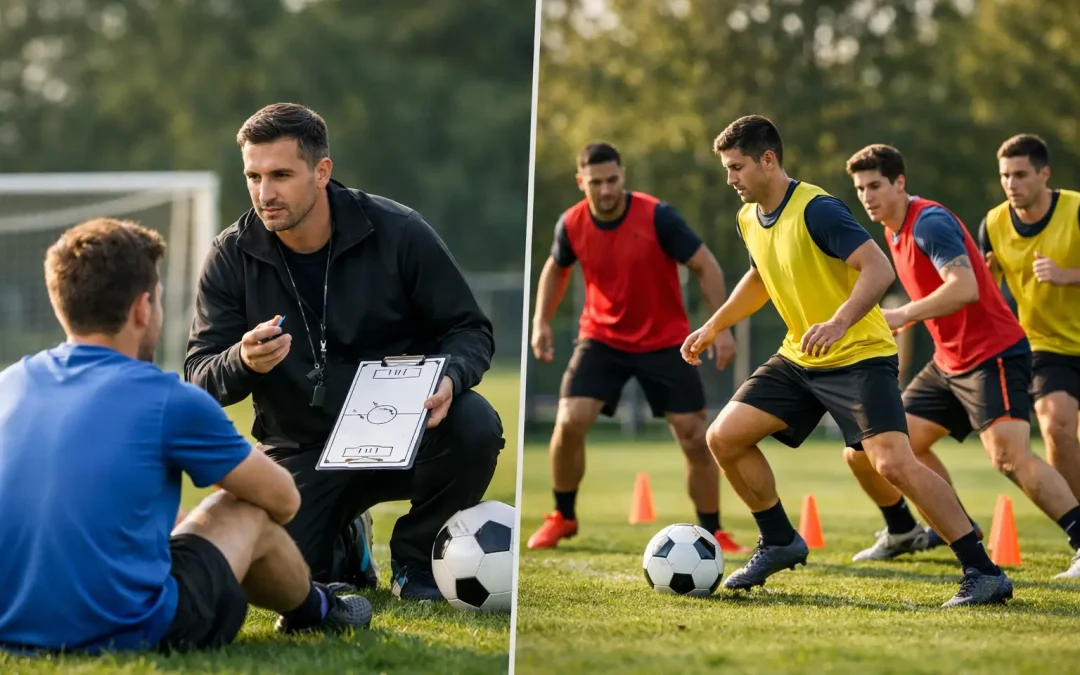
A player can train hard twice a week with their team and still feel stuck on game day. Their touch breaks down under pressure, their weaker foot gets avoided, or they keep hearing the same feedback without knowing how to fix it. That is usually where football coaching vs team training becomes a real question for players and parents – not which one is better in theory, but which one will actually move development forward.
The short answer is that they serve different purposes. Team training prepares a squad to play together. Football coaching develops the individual inside that team. When families understand that difference, it becomes much easier to choose the right environment at the right stage of a player’s journey.
Football coaching vs team training – what is the real difference?
Team training is built around the collective. A coach has limited time and a full group to manage, so sessions usually focus on shape, patterns of play, pressing triggers, transitions, set pieces, and game models. That is necessary work. Players need to understand their role, communicate with teammates, and function within the structure of the side.
Football coaching, particularly one-on-one or in small groups, is much more specific. It looks at the player’s individual game and asks direct questions. Is their first touch clean enough? Can they scan before receiving? Do they strike the ball properly with both feet? Are they confident in duels? Do they understand the tactical demands of their position? This format gives the coach time to isolate problems, correct technique, and build habits through repetition.
Both matter, but they do not produce the same outcomes. A team session cannot always stop and spend 15 minutes correcting one player’s body shape when receiving on the half-turn. A private or small-group coaching session can.
Why team training alone does not always solve individual weaknesses
For most clubs, team training has to serve the whole squad. That means coaches are balancing attendance, age level, tactics, fitness, match preparation, and behaviour management all in the same session. Even very good team coaches often cannot give every player the individual detail they need.
That is not a criticism of team training. It is simply the reality of working with groups. If a player needs repeated work on finishing technique, scanning habits, defending 1v1, or position-specific movement, the team environment may only expose the issue rather than correct it.
This is why some players look sharp in isolated moments but inconsistent across full matches. They are training with the team, but not always developing the personal tools required to execute under pressure. Improvement needs attention, repetition, and coaching feedback that is tailored rather than general.
A young winger, for example, may hear “be more aggressive” from the sideline. Useful intent, but incomplete. What they may really need is work on first-step explosiveness, receiving on the back foot, attacking the defender’s front foot, and delivering with quality after beating their marker. That level of detail sits more naturally in individual coaching.
What football coaching develops best
The biggest strength of football coaching is precision. Sessions can be built around the player’s age, position, goals, and current level. That makes progression easier to measure and easier to feel.
For younger players, that often means clean technical foundations. Ball mastery, passing mechanics, striking technique, coordination, balance, and confidence on the ball all improve faster when the coaching is direct and age-appropriate. Early habits matter. A player who learns proper technique young usually finds it easier to adapt as the game speeds up.
For older or more advanced players, the gains become even more targeted. A centre-back may need timing in duels and better distribution under pressure. A midfielder may need to scan earlier and play forward more consistently. A striker may need sharper movement across defenders and calmer finishing in the box. Position-specific coaching can turn vague ambition into practical development.
There is also a psychological benefit that families sometimes overlook. Players often gain confidence faster when they understand why they are making mistakes and how to correct them. Progress stops feeling random. They begin to recognise patterns in their own game, and that ownership carries into matches.
What team training develops best
Team training remains essential because football is not played in isolation. A player can have outstanding technique and still struggle if they do not understand spacing, timing, defensive responsibility, or how to combine with others.
This is where the team environment is irreplaceable. It teaches structure, accountability, decision-making within a system, and the rhythm of the game. Players learn when to press, when to drop, how to rotate positions, and how to respond to the strengths and weaknesses of teammates.
It also builds match habits that are hard to recreate in private sessions. Competing for positions, communicating in real time, and adapting to different opponents are all part of football development. Team training gives context to the individual work.
That is why the strongest pathway for most players is not one or the other. It is a combination where individual coaching sharpens the player and team training teaches them how to apply those gains within the game model.
Which option is right for your child or for you?
It depends on the player’s current needs, not just their age or ambition.
If a player is new to football, individual coaching can help build sound habits early. That can make club football less overwhelming and more enjoyable because the player feels capable rather than reactive. If a player already competes at club level but keeps facing the same limitations, extra coaching can address the gap more directly than waiting for it to improve on its own.
For representative-level players, academy players, or teenagers preparing for trials, the value becomes even clearer. At that stage, small margins matter. First touch, speed of execution, positional awareness, finishing quality, and confidence in duels can influence selection decisions. Generic work is rarely enough when the goal is to stand out in competitive environments.
For senior players, the same principle applies. Some need to sharpen after time away from the game. Others want to improve position-specific details or prepare properly for a season. Focused coaching gives them a more efficient way to work on performance than relying only on team sessions.
The trade-off parents and players should understand
Private coaching is not a replacement for football intelligence within a team. A player can become technically sharper through individual work, but they still need match exposure and team understanding. On the other hand, team training without individual correction can leave development too broad and too slow.
The best choice often comes down to what is missing. If the player lacks confidence on the ball, struggles with technique, or needs detailed feedback, football coaching is usually the faster solution. If they are technically sound but need to understand systems, timing, and collective play, team training carries more weight.
For many Sydney families, the most effective approach is using both with purpose. Not more training for the sake of more training, but the right training for the player’s stage. One session focused on individual development can often improve the quality of everything the player does with their team.
How to tell if a player needs extra coaching
There are some clear signs. Progress has plateaued despite regular team attendance. Match confidence drops when pressure increases. The player avoids certain actions, such as turning on the ball, using their weaker foot, or engaging in 1v1 moments. Coaches keep giving similar feedback each week, but the problem remains.
Another sign is when the player has a clear goal but no clear plan. Wanting to make a stronger team, prepare for trials, or improve in a specific position is a good start. What matters next is whether training is actually aligned to that goal. Targeted coaching creates that alignment.
This is where a development-focused environment matters. At Clinical Football, the value of private and small-group coaching is not just extra touches on the ball. It is structured progression, position-aware feedback, and serious attention to the full player – technical, tactical, physical, and mental.
Build the right mix, not just the busiest schedule
More sessions do not automatically mean more improvement. Poorly matched training can leave players tired without really moving them forward. The better approach is to identify what the player needs most right now and choose the format that develops it.
Football coaching vs team training is not really an argument once you understand the role of each. One builds the individual engine. The other teaches that engine how to perform within the team. When those two pieces work together, players improve with more clarity, more confidence, and a stronger sense of where their game is heading.
The goal is not to keep a player busy. The goal is to help them train with purpose, grow with confidence, and be ready when their next opportunity arrives.