
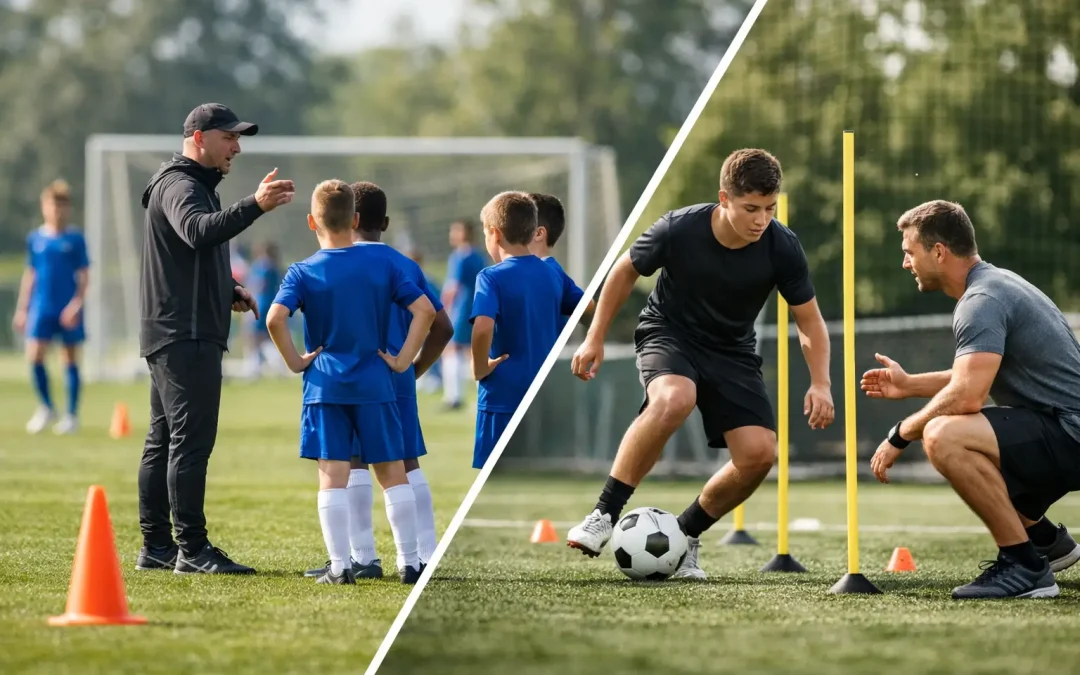
A player trains twice a week with their team, works hard, and still feels half a step behind at trials. Another player is busy every afternoon in an academy environment, yet the same weaknesses keep showing up on match day. That is where the question of football academy vs private training becomes real for families. It is not about which option sounds more serious. It is about which environment gives a player the right type of development at the right time.
For many Sydney parents, the decision comes down to progress. You want coaching that improves technique, builds confidence, and prepares your child for the level they are aiming for. The best choice depends on age, personality, current standard, and what the player actually needs most – repetition, game understanding, physical development, confidence, or individual correction.
Football academy vs private training: what is the difference?
A football academy usually offers structured group-based development. Players train in a set program, often with others of a similar age, and work through drills, game scenarios, and broader football habits. This can be excellent for learning within a football environment, developing rhythm, and adapting to pressure from other players.
Private training is different. It focuses on the individual. Sessions are built around one player’s strengths, weaknesses, position, goals, and rate of learning. Instead of fitting into a group plan, the player receives coaching tailored to what will help them improve fastest and most effectively.
Neither format is automatically better. Each serves a purpose. The key is understanding what problem you are trying to solve.
When a football academy makes sense
Academy training can be a strong option for players who need consistent structure and regular exposure to game-based learning. In a quality academy setting, players can improve their first touch, passing, movement, scanning, and decision-making while training around others who challenge them.
This matters because football is not played in isolation. A player must read cues, react quickly, and make decisions under pressure. Group training helps develop these habits in a way that feels closer to real match conditions.
For younger players, academies can also create routine and enjoyment. They learn to train with focus, listen to coaching, and build discipline in a football environment. For older players, academy sessions can provide useful intensity and opportunities to sharpen performance against peers.
That said, academy training has limits. In a group, coaches cannot stop every repetition to fix every technical detail. If a player has a weak first touch, poor passing mechanics, limited confidence on their non-dominant foot, or position-specific gaps, those issues can stay hidden for months. The player stays active, but progress is not always precise.
When private training makes sense
Private training is most valuable when a player needs direct intervention. That might mean correcting technique, preparing for trials, improving speed of execution, building confidence after a poor season, or developing the demands of a specific position.
The biggest advantage is attention. A coach can identify exactly what is holding the player back and coach it properly. If a winger struggles to beat defenders, the session can focus on timing, body shape, first-step explosiveness, and end product. If a central midfielder receives side-on but scans too late, that can be addressed repeatedly until it becomes habit. If a goalkeeper needs work on footwork, handling, or distribution, the session can be built around those details.
This level of specificity often leads to faster gains. Players get more ball contact, more correction, and more repetition of the exact actions they need.
Private training also helps players who are talented but inconsistent. Sometimes the issue is not effort. It is clarity. Once a player understands what to focus on and why it matters, confidence tends to rise with performance.
The trade-off parents should understand
The biggest mistake is assuming more sessions always means better development. Volume without purpose can leave a player busy but unchanged.
An academy offers variety, competition, and football context. Private training offers focus, correction, and individual progression. If a player only trains in groups, they may not receive enough personal feedback. If a player only trains privately, they may improve technically but miss some of the pressure and adaptation that comes from working around others.
That is why the answer to football academy vs private training is often not either-or forever. It is about what the player needs now.
A beginner may benefit from group exposure to learn the basics and enjoy the game. A developing player chasing representative football may need private sessions to close the gap in specific areas. An advanced player may need both – group work for game realism, private coaching for precision.
Which players benefit most from academy training?
Academy training often suits players who are still building their overall football foundation. It can also suit players who thrive in social environments and respond well to peer competition. Some players lift their standard when they train around others. They become sharper, more alert, and more determined.
It is also useful for players who need to improve general football behaviours rather than one isolated weakness. Movement off the ball, communication, pressing triggers, and decision-making in tighter spaces can all improve in the right group setting.
Parents should still look closely at coaching quality. A strong academy is not just cones and lines. It should have a clear development structure, high standards, and coaching that goes beyond keeping players occupied.
Which players benefit most from private training?
Private training suits players with specific goals and specific gaps. That includes players preparing for trials, returning from a dip in confidence, moving into a new position, or trying to break through at a higher level.
It is especially effective for players who are motivated but need a more personal coaching environment. Some children get lost in groups. Others are too hesitant to express themselves when they know everyone is watching. In one-on-one or small group work, they often relax, absorb information better, and start to play with more belief.
Parents also appreciate the transparency. You can usually see what is being worked on, why it matters, and how it connects to match performance. Progress feels measurable rather than vague.
At Clinical Football, this player-centred approach is a major reason families choose private coaching. The focus is not simply on doing more training. It is on building the complete player through structured improvement.
Cost, commitment, and value
Budget matters, and it should be part of the decision. Academy programs are often more affordable per session because the coaching cost is spread across a group. Private training is a higher investment, but it offers a different level of detail and personalisation.
The better question is not just what costs less. It is what delivers value for your player. If a child needs confidence, technical correction, and a plan, one quality private session per week may do more than several generic sessions. On the other hand, if they need more football exposure and routine, an academy may be the smarter starting point.
Commitment matters too. Private coaching works best when players are ready to listen, apply feedback, and practise with intent. Academy training works best when standards are consistent and the player is placed in a group that genuinely challenges them.
How to choose the right option for your child
Start with an honest assessment. Is your child lacking football understanding, or are they lacking technical execution? Do they need confidence, intensity, correction, or more game-like repetition? Are they cruising at their current level, or struggling to keep up?
Then consider personality. Some players love the energy of a group. Others improve fastest when the coach can slow things down, explain clearly, and repeat key details without distraction.
Finally, think about timing. Before trials, private training can be extremely effective because it sharpens the details that selectors notice. During a longer development phase, academy work can help maintain rhythm and match-relevant habits. Across a season, many players benefit from a mix that changes as their needs change.
The smartest approach is often a combination
For ambitious players, combining academy training with private coaching often creates the strongest development pathway. Group sessions provide competition, pressure, and football context. Private sessions target the specific technical and tactical details that make a player more effective in those moments.
That combination can be powerful because it connects learning to performance. A player works on scanning, body shape, and passing speed privately, then applies it in a group or match setting. They improve their weaker foot in focused training, then trust it under pressure on game day. Confidence grows because the player is not guessing anymore. They know what they are doing and why.
The best training environment is the one that moves a player forward with purpose. If your child needs broad exposure, an academy may be the right fit. If they need targeted development, private training may be the difference-maker. And if they are serious about reaching the next level, the real advantage often comes from choosing the right blend at the right stage of their journey.
The goal is not to keep players busy. It is to help them develop with clarity, confidence, and a training plan that matches their potential.